Jesús Owono, FC Andorra's goalkeeper, has been suspended for 12 matches for the challenge that felled CD Tenerife's Jesús de Miguel. Near the end of the Nov. 2 match in Tenerife, de Miguel was chasing a high ball in midfield when Owono, charging far out of his penalty area, struck him in the chest. Twelve matches is the maximum suspension a player can receive. Gerard Piqué, FC Andorra's owner, came to his goalkeeper's defense, criticizing the Spanish federation for what he called an excessive punishment.
Why 12 matches?
Piqué argued that the federation had judged the consequences of the challenge rather than the challenge itself. Readers may have noticed that I wrote that de Miguel "played" for Tenerife, in the past tense. That is because the consequences were fatal. De Miguel went into cardiac arrest immediately after the collision and died in a hospital the next day.
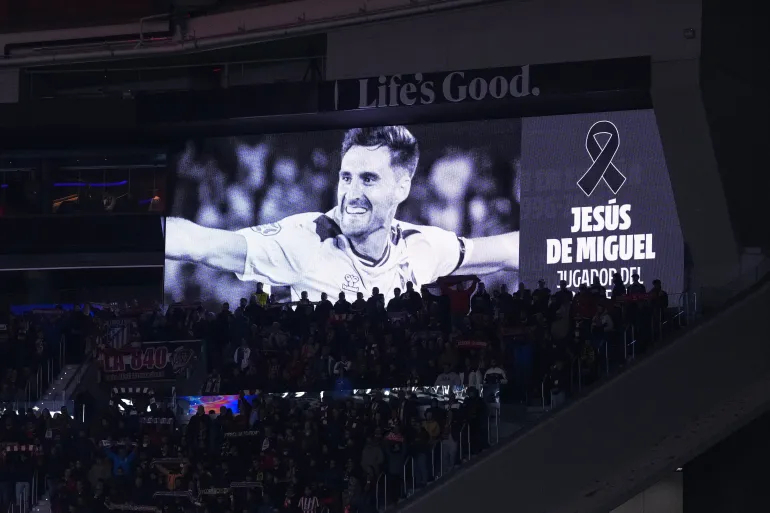
The news stunned the football world, and tributes poured in. The Spanish federation paused matches in the ninth minute, in honor of his shirt number, played a video tribute and resumed play after a round of applause. Sympathy also flowed toward Owono, who must now carry the weight of that moment for the rest of his life.
Collapses on the football field
Until Marc-Vivien Foé collapsed in 2003, I had assumed that elite athletes were somehow immune to heart conditions, that these were afflictions of old age. Since then, I have watched three collapses unfold live on television and read about others in the news afterward: Fabrice Muamba, Christian Eriksen and Antonio Puerta. I was overjoyed when Muamba, in 2012, and Eriksen, in 2021, came back from the brink. Puerta was not so fortunate. He collapsed in 2007 and died three days later in a hospital in Seville. He was 22, and had come up through Sevilla's academy alongside Sergio Ramos.
Muamba: 78 minutes between death and rebirth
Fabrice Muamba is lucky to be alive. He was also extraordinarily lucky in where he collapsed, surrounded by some of the best medical help imaginable. On March 17, 2012, Muamba was playing for Bolton Wanderers against Tottenham Hotspur in an F.A. Cup quarterfinal at White Hart Lane when, away from the ball, he toppled to the turf like a felled tree. He did not even put out his arms to break his fall.
Medical staff began CPR (cardiopulmonary resuscitation) immediately, and Muamba received 15 defibrillator shocks, first on the pitch and then in the ambulance on the way to the hospital. Muamba was also blessed that Dr. Andrew Deaner, a cardiologist, was in the stands watching the match. Deaner guided the medics administering the shocks and, crucially, persuaded them to take Muamba to the London Chest Hospital in Bethnal Green rather than North Middlesex Hospital, which was much closer to White Hart Lane. The London Chest Hospital had the equipment and the expertise to handle a case like Muamba's.
Against all expectations, after 78 minutes in which machines and medics kept him alive, Muamba's heart began beating on its own again. Two days later, he regained consciousness and recognized his fiancée, Shauna Magunda. He retired from football later that year and went on to coaching, punditry and campaigning for cardiac awareness.
Eriksen: An implantable defibrillator at work
Christian Eriksen went into cardiac arrest while playing for Denmark against Finland at the European Championship in June 2021 (the tournament was still called Euro 2020). He received medical attention within seconds of collapsing. After he was resuscitated and defibrillated on the field, officials at Copenhagen's Rigshospitalet said that Eriksen had been stabilized and was awake.
Remarkably, Eriksen returned to football. He was fitted with an implantable cardioverter-defibrillator, or ICD, a device that delivers an electrical shock when it detects an abnormal heart rhythm. With the ICD in place, he went on to play for Brentford, Manchester United and Wolfsburg. In 2026, he collapsed again, this time in a match against Ukraine. The ICD did exactly what it was designed to do: Eriksen regained consciousness and walked off the pitch.
Cardiac arrest is not a heart attack
I had always assumed that cardiac arrest and a heart attack were the same thing, until I read an article about Muamba. A heart attack occurs when a clot starves the heart of blood and oxygen, damaging the heart muscle itself. Cardiac arrest occurs when the electrical impulses that regulate the heartbeat malfunction, sometimes because the walls of the heart have become inflamed or damaged, and the heart suddenly stops pumping.
Authorities step in
After the collapses of Foé, Miklós Fehér and Muamba, football's governing bodies adopted stringent precautions to detect heart problems long before a player goes down. Players at FIFA tournaments must undergo cardiac screening beforehand, including an electrocardiogram (ECG) and an echocardiogram. UEFA has introduced similar screening for players in its competitions, such as the Champions League.
Authorities have also worked to ensure that a stricken player can be treated within minutes, before he ever reaches a hospital. Major competitions and leagues now require a defibrillator at pitchside rather than somewhere deep inside the stadium, and money has been directed to putting defibrillators in grassroots clubs.
Let us hope we never witness another collapse on a football pitch. And if one does happen, let the player join the list of those who survived: Eriksen, Muamba and Daley Blind.


