The Red That Wasn’t: Kalulu, Bastoni, and Football’s Long Memory of “Theatrical” Sendings‑Off
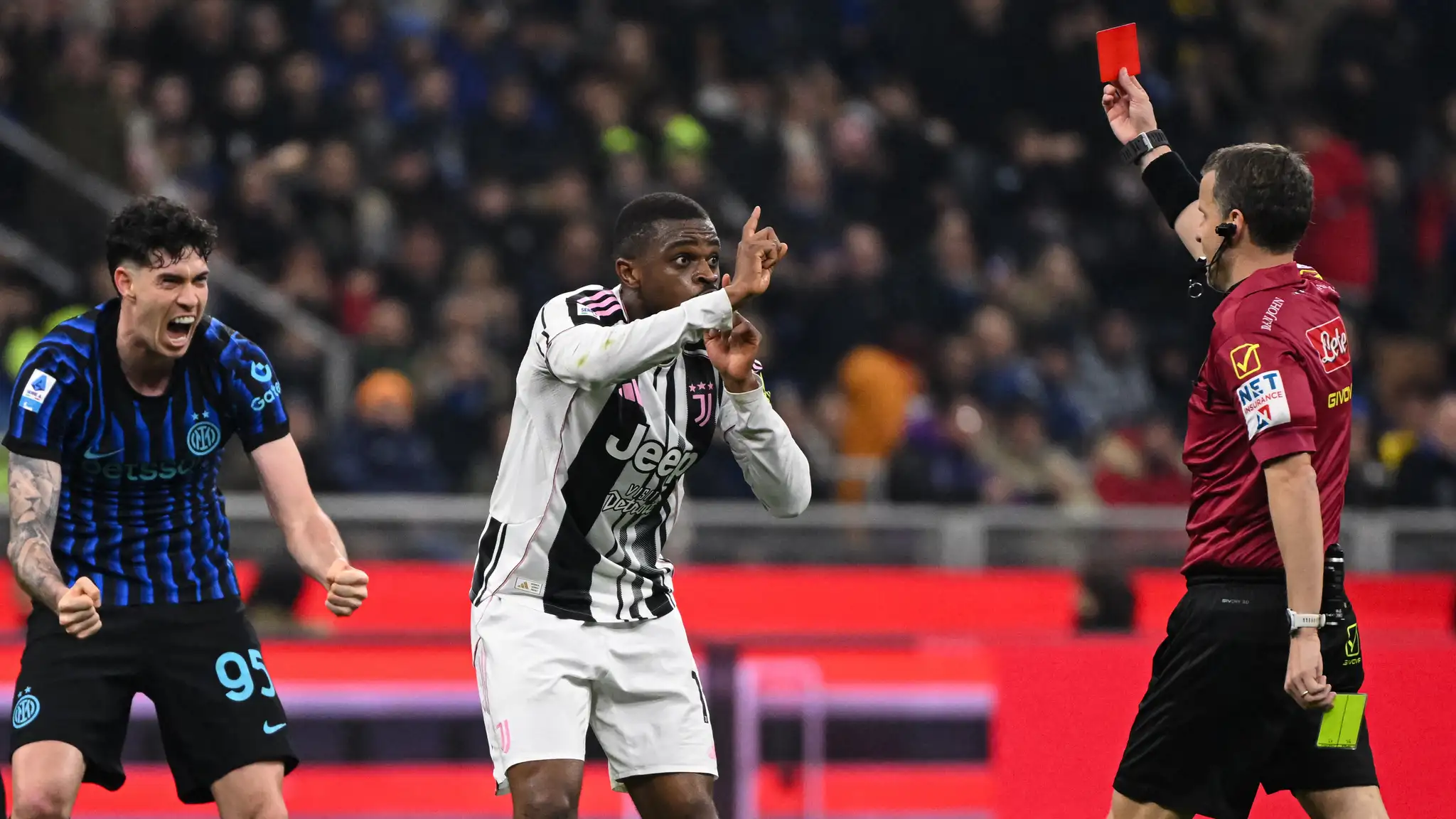
The Derby d’Italia should have been defined by tactical swings and game state shifts. Instead, it was defined by an irreversible decision: Pierre Kalulu, already booked, shown a second yellow after minimal contact with Alessandro Bastoni. Serie A referees’ chief Gianluca Rocchi later called the decision “clearly wrong,” noted “clear simulation,” and confirmed VAR could not intervene because it was a second yellow. Juventus lost 3–2. Source · ANSA report
The incident sits in a long‑running subset of refereeing controversies: cases where a second yellow or straight red is triggered not by the force of contact itself but by how that contact is framed. These moments tend to persist in the public memory because they do two things at once: they change game state, and they generate a counterfactual — what the match might have been without the decision.
Second Yellows and Straight Reds: A Short, Consequential History
-
Rivaldo vs Turkey, World Cup 2002 — second yellow
Hakan Ünsal, already booked, was sent off after kicking the ball at Rivaldo; the ball hit Rivaldo’s leg, but he went down clutching his face. FIFA later fined Rivaldo for simulation, making it a rare case where post‑match disciplinary action acknowledged the exaggeration. Source -
Beckham vs Argentina, World Cup 1998 — straight red
Diego Simeone later admitted his fall “transformed a yellow card into a red card,” a retrospective acknowledgment of how player reaction can influence sanction severity. S ource -
Busquets vs Inter, Champions League semi‑final 2010 — straight red
Thiago Motta’s dismissal turned on an incident in which Sergio Busquets appeared to exaggerate contact. Motta later described the reaction as “theatre,” underscoring how interpretation and performance can compound in high‑stakes matches. Source -
Pepe vs Barcelona, Champions League semi‑final 2011 — straight red
Pepe’s red for his challenge on Dani Alves became the focal point of that tie. Real Madrid’s official protest argued that opponents exaggerated contact, illustrating how claims of simulation become part of a club’s post‑match strategy. Source
What the Kalulu Incident Demonstrates
Kalulu’s dismissal highlights a structural limit of officiating: the VAR protocol’s inability to review second‑yellow incidents. That creates a narrow zone in which simulation has disproportionate impact. The referee’s first‑order perception becomes final, even if video evidence later undermines it.
That is why Kalulu’s case resonates beyond Juventus. It is not just about error; it is about the category of error that the system cannot correct.
Conclusion
Football does not need to eliminate contact or controversy — those are features, not bugs. But it does need to reduce the number of decisive calls where the dominant variable is reaction rather than action. The historical record shows how quickly a single red can reshape a game or tournament; Kalulu’s second yellow is the latest data point in that pattern.