My Journey as a Blue and White supporter
As Phil Knight wrote in his book Shoe Dog, sports give people a sense of having lived other lives, of taking part in other people's victories. And defeats. When sports is at it's best, the spirit of the fan merges with the spirit of the player.
I have followed Argentina since the 1990 FIFA World Cup, a loyalty that took root in the legend of Maradona — in stories of hand of god, and of a goal scored dribbling seven players. That devotion has endured through all that followed: the near misses, the humiliations, and the long, arid stretch from the 1990s through to 2020's in which every trophy remained persistently, just beyond reach.
What follows is my recollection of Argentina's World Cup journey — the defeats that wounded, and the one victory that made it all worthwhile.
1990: Argentina 0 - 1 West Germany(8 July 1990)
Italia 90 is the first World Cup I have any living memory of watching soccer on television. I have a dim but cherished recollection of the final between Argentina and West Germany — sitting with my paternal grandfather and my maternal cousins, Gibi and Vibin, as the match unfolded on screen. I believe, it was through those evenings watching games on Doordarshan, India's national television broadcaster, that my love for football quietly took root.
Italia 90 is widely regarded as the most boring World Cup on record, notorious for producing the lowest average goals per game in the tournament's history. The relentlessly defensive nature of the competition prompted FIFA to subsequently abolish the back-pass rule, preventing goalkeepers from handling deliberate passes from their own teammates.
Despite the grim spectacle, Argentina — under coach Carlos Bilardo — navigated their way to the final through successive penalty shootout victories in both the quarter-final and semi-final. The summit clash was a repeat of the 1986 final, once again pitting Argentina against West Germany. It also made history for grimmer reasons: Pedro Monzón and Gustavo Dezotti became the first players ever to be sent off in a World Cup final. Argentina ultimately fell 1-0 to a late Andreas Brehme penalty.
One bright moment amid an otherwise faltering campaign was their victory over Brazil in the Round of 16 — the first time Argentina had ever beaten their great rivals in a World Cup.
1994: Argentina 2 - 3 Romania (3 July 1994)
By the time USA 94 came around, I was studying at a residential school(JNV Mayannur), which meant I missed Argentina's defeats to Bulgaria and Romania. Fortunately, their first two group stage matches — against Greece and Nigeria — coincided with my vacation, so I was able to watch those from home. The remainder of their campaign, including the group stage loss to an impressive Bulgaria side and the Round of 16 exit against Romania, passed me by while I was back at school. It was also around this edition that I began to fully embrace football tribalism — firmly in the Argentina camp, and very much against Brazil.
This World Cup proved to be a deeply disappointing one for Argentina. The tournament was overshadowed by the shocking ban of Diego Maradona, who was expelled after failing a doping test following the group stage match against Nigeria. His absence cast a long shadow over the rest of Argentina's campaign, and the team never truly recovered. Beyond Gabriel Batistuta's brilliant hat-trick against Greece, Argentina offered their fans precious little else to celebrate or remember.
1998: Argentina 1 - 2 Netherlands (4 July 1998)
Having finished my secondary schooling in 1998 from same school, I was able to watch the entire tournament from home. I watched Argentina's elimination alongside my father, cousins and neighbors.
Under coach Daniel Passarella, Argentina were solid and disciplined, keeping a clean sheet throughout the group stage. They advanced to the quarter-finals after a dramatic penalty shootout victory over England — a match that also produced a red card to David Beckham for fouling Diego Simeone. Hopes were high going into the quarter-final against the Netherlands, and understandably so.
But the Dutch were something else entirely. That Netherlands side was the golden generation forged by Ajax's extraordinary 1995 European Cup winning team, and they played with a grace and fluency that was a joy to watch. They dominated Argentina and sealed the win with one of the most iconic goals in World Cup history — Dennis Bergkamp's breathtaking late winner, a moment of pure genius that still stands the test of time.
To this day, if anyone asks me which team I watched truly deserved to win a World Cup but never did, my answer is always the Netherlands of 1998.
2002: Argentina 1 – 1 Sweden (June 12, 2002)
The 2002 World Cup was the first edition in India not broadcasted by Doordarshan, with Ten Sports acquiring the rights as a private broadcaster — a change that many may remember distinctly. I was doing my graduation from SSCET in Tamil Nadu at the time, and fortunately missed Argentina's painful group stage exit against Sweden.
Argentina arrived in Japan and South Korea as strong favourites, having topped the CONMEBOL qualifying table and riding high on a squad brimming with flair and attacking talent, guided by the tactically brilliant Marcelo Bielsa. They were placed in a formidable Group — alongside England, Sweden, and Nigeria — a group widely dubbed the Group of Death.
Against Nigeria and Sweden, Argentina played with real intent, creating more than enough chances to suggest they belonged among the tournament's contenders. But a narrow, damaging defeat to England — settled by a David Beckham penalty — proved fatal to their campaign. Despite drawing with Sweden in their final group game, it was not enough to see them through. They were eliminated at the group stage, much to my agony, in what remains one of the biggest shocks of that tournament.
2006: Argentina 2 – 4 Germany (30 June 2006)
By 2006, I was well into my professional life — in my second year at HCL Technologies in Chennai — and I watched Argentina's quarter-final exit against Germany from the office.
It was, in many ways, a redemptive campaign after the heartbreak of 2002. Argentina produced some genuinely thrilling moments: a breathtaking goal against Serbia & Montenegro that is still spoken of as one of the finest ever team goal scored at a World Cup, Maxi Rodríguez's stunning extra-time volley against Mexico in the Round of 16, and the emergence of a teenage Lionel Messi on the world stage for the first time.
Against hosts Germany in the quarter-final, Argentina took the lead and chose to sit deep and defend it in final stages — a decision that ultimately cost them. Coach José Pékerman's substitution of the creative Juan Román Riquelme for the defensive Esteban Cambiasso signalled a retreat into caution. More controversially, having used all three substitutions, Pékerman had no option to introduce Messi when the game hung in the balance. Germany equalised, and Argentina were eliminated on penalties.
As for the tournament as a whole, Germany 2006 will forever be remembered for a very different reason — Zinedine Zidane's infamous headbutt on Marco Materazzi in the final, a jarring and unforgettable last act from one of the greatest players the game has ever seen.
2010: Argentina 0 – 4 Germany (3 July 2010)
The 2010 World Cup coincided with the beginning of a new chapter for me — I recently joined Juniper Networks and had relocated to Bengaluru from Chennai a few months before the tournament, a city I continue to call home to this day.
Argentina arrived in South Africa under the most romantic of appointments — Diego Maradona himself in the dugout. On paper, the squad was dazzling: Messi at the peak of his powers, flanked by the likes of Sergio Agüero, Ángel Di María, and Gonzalo Higuaín. Yet for all their attacking firepower, Argentina never truly functioned as a cohesive unit. The team existed in two disconnected blocks — a brilliant attacking line and a defensive one — with very little holding them together. The chronic weakness at the back was exposed ruthlessly, and Germany, once again, were the ones to administer the lesson, routing Argentina 4-0 in the quarter-finals.
The story of that World Cup, however, belonged to Spain. Powered by the core of a generational FC Barcelona side, they played a brand of football — Tiki-taka — that was unlike anything the tournament had seen before. Patient, precise, and suffocating, they were worthy champions, with Andrés Iniesta delivering the decisive moment: a composed extra-time finish in the final to sink the Netherlands and hand Spain their first ever World Cup.
2014: Argentina 0 - 1 Germany (14 July 2014)
By 2014, life settled. Married and living in Electronic City, Bengaluru, with little Jeni having arrived just a year earlier, I watched the Brazil World Cup with a sense of genuine optimism. From 2014 onwards, watching the World Cup has quietly become a solitary affair — just me, alone at home, no longer gathered around a screen with family or friends as in years gone by.
Under coach Alejandro Sabella, Argentina had shown considerable improvement in qualifying, and despite their persistent defensive frailties, they had quietly built a more disciplined and purposeful side. Blessed with a favourable run of fixtures, they navigated their way to the final — the first time in my conscious, fully formed memory that I had seen Argentina in a World Cup final.
Their opponents, for the third time, were Germany. It was a tight, tense affair — nothing like the routs of 2010. Argentina had a clear game plan and executed it well, going toe to toe with the best team in the world. Gonzalo Higuaín's missed chance at a crucial moment remains one of those painful what-ifs, and had it gone in, history might have been written very differently. In the end, Mario Götze's sublime extra-time finish settled it, and Argentina were runners-up once more.
My personal belief remains that had the Messi of 2010 — explosive, unstoppable, and at his very best — shown up in 2014, Argentina would have won that World Cup. Coming off a difficult season at FC Barcelona, Messi was influential in the earlier rounds but faded as the pressure mounted in the latter stages.
And then there was the other defining moment of that tournament — one that has never lost its joy in retelling: Germany's extraordinary 7-1 demolition of hosts Brazil. For those of us in the Argentina camp, it remains a highlight of a very personal kind, and something that has been gleefully wielded against our Brazilian rival fans ever since.
2018: Argentina 3 - 4 France (30 June 2018)
On the surface, little had changed in my life between 2014 and 2018 — still at Cisco, still in Electronic City, still watching alone. But Argentina's trajectory had taken a worrying turn.
The years between the two tournaments had been turbulent for the national side. Back-to-back Copa América final defeats, a revolving door of managers, and a qualification campaign so disastrous that it took a Messi hat-trick in the thin air of Quito — single-handedly rescuing Argentina against Ecuador on the final matchday — to even reach Russia.
The struggle carried seamlessly into the tournament itself. A damaging 3-0 loss to Croatia, a frustrating draw against debutant Iceland in which Messi missed a penalty, and a nerve-shredding final group game against Nigeria, salvaged only by a late Marcos Rojo volley — it was an anxious, patchwork campaign from start to finish. Even the knockout stage offered no relief, as a brilliant Kylian Mbappé ran riot against Argentina's threadbare defence, and a thrilling 4-3 defeat to France ended their journey in the Round of 16.
By then, Messi was 31. And with that, my long-held dream of seeing him lift the World Cup felt, for the first time, like it was truly slipping away.
2022: Argentina 4 - France 2 (18 December 2022)
By 2022, life had grown fuller in every sense. With little Jessi having arrived EXACTLY 4 years earlier on 18th December, we were now a family of four — and Argentina, remarkably, had transformed into a team worthy of genuine belief. They arrived in Qatar on the back of an extraordinary 36-match unbeaten run, and this was a very different Argentina from the fragile sides of previous editions. Cristian Romero brought steel and composure to the defence, Enzo Fernández and Alexis Mac Allister provided dynamism and intelligence in midfield, and the partnership of Lautaro Martínez and Julián Álvarez gave Messi the support he had always deserved. But for me personally, the single most transformative factor was Emiliano Martínez between the posts. For years, Argentina's goalkeepers had been a source of quiet anxiety — prone to punching when they should have held, uncertain with the ball at their feet. Dibu Martínez was something else entirely.
The tournament began with the shock of all shocks — a defeat to Saudi Arabia — but what followed was a relentless march through the draw. Argentina dominated every opponent until, in the 80th minute of the final against France, Kylian Mbappé seized the stage and turned what seemed like a comfortable victory into the most breathtaking finale the World Cup has ever produced. Rest is history.
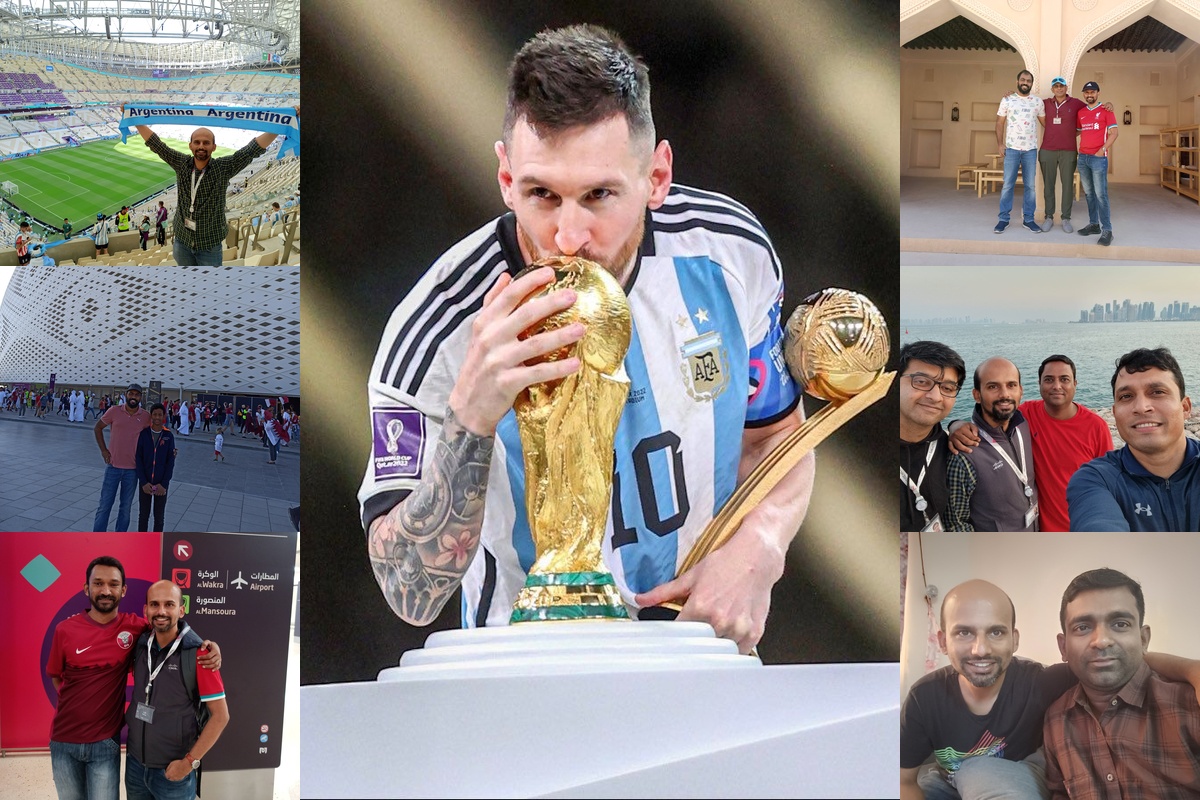
Yet what makes 2022 truly extraordinary for me is not just what happened on the pitch. My sister had moved to Qatar a few years prior, and I seized the opportunity — arriving a week before the tournament began and staying for the entirety of it. I spent almost every match day at the FIFA Fan Festival, soaking in an atmosphere unlike anything I had experienced. I was in the stands for Argentina vs Saudi Arabia, watched Qatar vs Senegal, and — most memorably — witnessed Argentina's dramatic quarter-final victory over the Netherlands in person.
After decades of watching Argentina's heartbreaks from living rooms in Chennai, Bengaluru, and everywhere in between, fate had finally placed me in the right city at the right moment. When they lifted that trophy, I was there — and all those years of loyalty, hope, and heartbreak felt, in that instant, entirely worth it.
2026: Canada, USA, Mexico
Having witnessed Argentina lift the trophy in Qatar, the build-up to this edition has felt remarkably different — quieter, more detached. The hunger and anxiety that defined every previous World Cup for me simply isn't there this time. Argentina's prospects are not something I find myself losing sleep over, and if I am being honest, I personally feel Messi should have walked away after 2022 — retiring as a champion, his story complete and perfect.
This time around, my heart is nowhere. But for the brand of fluid, attacking football they play, Spain are the team I would love to see go all the way. And then there is the Netherlands — a nation whose footballing identity has long been synonymous with beauty and brilliance, yet who remain the most decorated side never to have won the World Cup. When they produced that magnificent 1974 team under Cruyff, the world fell in love. The class of 1998 came achingly close. Whenever they manage to nurture another generation of that quality, I will be willing them on — because few things in football would feel more deserved than the Netherlands finally claiming the one trophy that has eluded them.