In football, the final day of a season or qualifying campaign occasionally produces outcomes that the numbers suggested were possible but nobody expected to happen. This is about two of them — one in club football, one in international qualifying — where the math was met exactly.
Frankfurt, Germany — May 1999
Going into the final day of the 1998-99 Bundesliga season, three points separated five clubs — Eintracht Frankfurt, Hansa Rostock, SC Freiburg, VfB Stuttgart and Nürnberg — for the single relegation spot. Bochum and Borussia Mönchengladbach had already been consigned to relegation.
Frankfurt were beating Kaiserslautern, the reigning champions, 3-1 with ten minutes left — safe, for the moment. Then, with eight minutes remaining, Rostock scored again in their own game to lead 3-2, and Nürnberg pulled one back. In real time, the relegation picture shifted from points to goal difference. Frankfurt were now going down even while winning. Bernd Schneider made it 4-1 — his last touch for the club before joining Bayer Leverkusen — but that still wasn't enough. The calculations elsewhere kept Frankfurt in the drop zone.
In the 89th minute, Norwegian striker Jan Aage Fjørtoft received the ball, produced a step-over and finished to make it 5-1. That single goal was the margin. At the exact same moment in Bavaria, Freiburg goalkeeper Richard Golz held onto the ball after Marek Nikl's shot cannoned off the post, preventing the rebound that would have saved Nürnberg. Frankfurt survived on goals scored. Nürnberg, who had started the day four places clear of trouble, were relegated.
Seville, Spain — December 1983
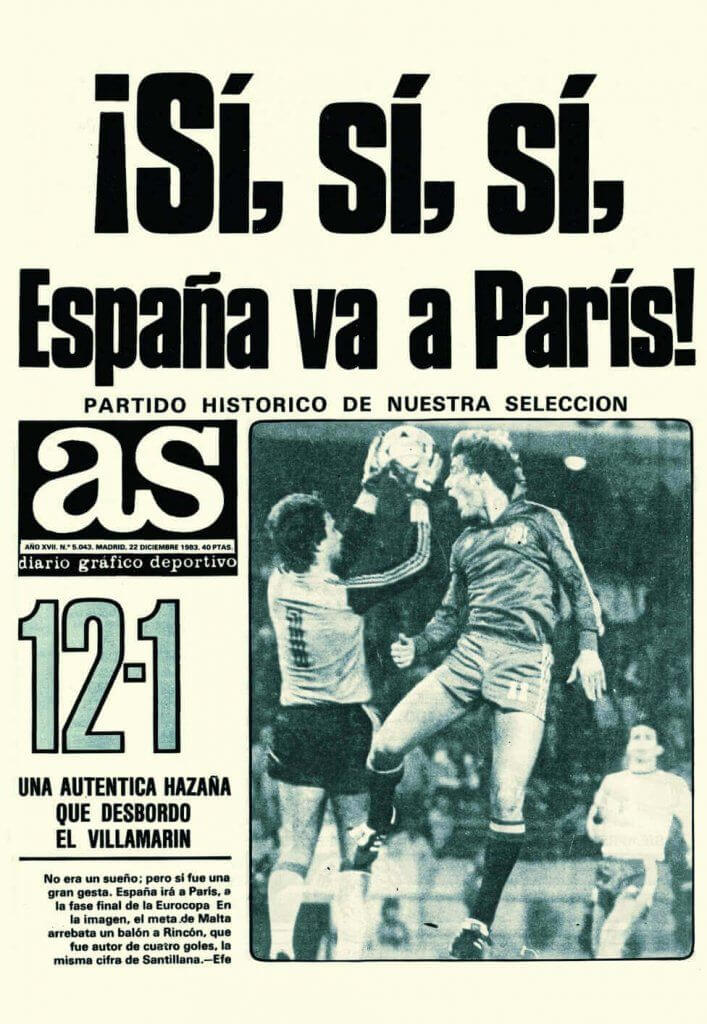
The Netherlands had just beaten Malta 5-0 in Rotterdam, leaving them top of Euro 84 qualifying — two points above Spain with an 11-goal advantage. Spain's final game was also against Malta, four days later. The requirement: win by 11 goals or more.
Malta had never lost by 11 in their history. Their worst defeats were 8-0 to West Germany and 9-0 to East Germany and Austria. Spain themselves had only scored 12 goals across their previous seven group matches combined. Malta Goalkeeper John Bonello was direct: "Spain couldn't score 11 goals against a team of children."
Spain postponed their La Liga weekend to prepare. Heavy rain soaked the Estadio Benito Villamarín, preventing Malta from training on the pitch. Manager Miguel Muñoz set up in a 3-3-4 formation. In the third minute, Juan Antonio Señor hit a penalty against the post. Santillana scored in the 15th minute, Malta equalised in the 24th. Santillana completed a hat-trick by half-time, but Spain led only 3-1. They needed nine goals in the second half without conceding.
Rincón scored in the 46th and 55th minutes. Then three goals in three minutes: Maceda in the 60th, Maceda again in the 62nd, Rincón in the 63rd — 8-1, with 27 minutes left. Santillana and Rincón each scored their fourth goals of the night in the 75th and 78th minutes. A Malta defender was sent off for time-wasting. Sarabia made it 11-1 in the 79th minute.
Spain needed one more, against ten men, in ten minutes. In the 86th minute, Señor fired home from 18 yards — the same player who had missed the third-minute penalty. 12-1. Spain were through and went on to play finals in Euro 1984 against France.
What these two days share
Both outcomes were mathematically possible — but neither was considered likely. Goals scored at the right moments, results shifting elsewhere in real time, and individual actions deciding collective fates. Football's points and goal tallies are built up over months, but they remain open to revision until the final whistle of the final game. These two days are good reminders of that.


